Pearls Before Punks: The Art of Weaponizing Tradition Against Itself

There's something almost poetic about watching a pearl necklace rest against a shredded fishnet top. Or seeing a Fair Isle cardigan pinned with a Victorian mourning brooch, layered over a corseted midi skirt in ink-black satin. These aren't accidents. They're arguments — quiet, gorgeous, fully intentional arguments about who gets to own the language of "good taste."
The alt community has always been fluent in contradiction. But lately, the conversation has shifted from pure rejection of mainstream aesthetics toward something more nuanced and, honestly, more powerful: absorption. Taking the symbols of tradition, of propriety, of pearl-clutching conservatism — and making them do completely different work.
This is the quiet rebellion. And it's louder than anything a mohawk ever said.
The Pieces That Started It All
Let's talk specifics, because this trend lives in the details.
Pearls are maybe the most loaded symbol in this conversation. For generations, they've been shorthand for a very particular kind of femininity — restrained, respectable, aspirational in the most conventional sense. Jackie Kennedy. Church mothers. Debutante balls. The pearl said: I know the rules. I follow them. I belong here.
What happens when you layer a triple-strand pearl choker over a black turtleneck with a silver septum ring framing your face? The pearl doesn't disappear — it amplifies. It creates friction. Suddenly it's not about belonging anywhere. It's about showing up somewhere uninvited and looking better than everyone who was supposed to be there.
Designers in the alt space have been leaning into this hard. Brooklyn-based label Vesper Thorn built an entire SS collection around what designer Maya Reyes calls "inherited elegance with a cracked surface" — pearl-encrusted chokers soldered to spiked hardware, strand bracelets knotted with black silk ribbon, single earrings that pair a baroque drop pearl with a dangling inverted cross. The message isn't anti-pearl. It's anti-deference.
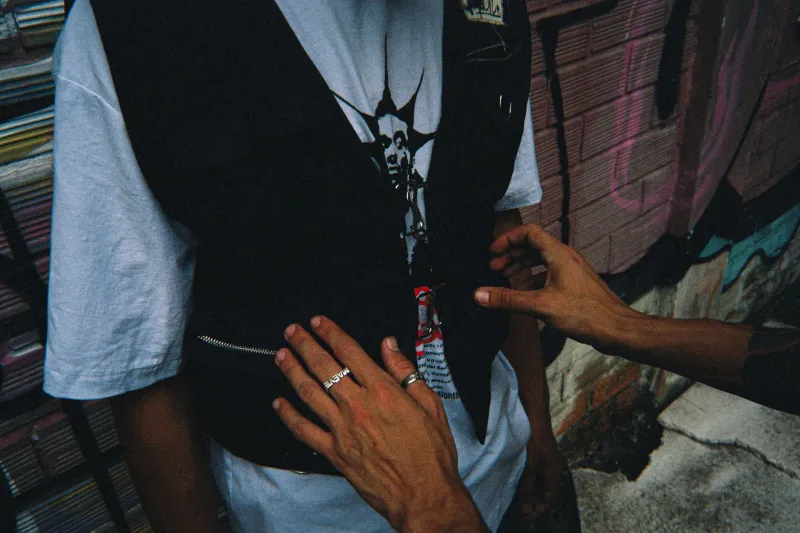
Cardigans are another fascinating case study. The cardigan has spent decades as the uniform of the unthreatening — the librarian, the suburbanite, the person who would very much like to speak to a manager. But oversized grandpa cardigans in oatmeal and dusty rose are showing up in alt wardrobes now, styled with leather harnesses underneath, or worn backwards over nothing but a bralette, or belted aggressively at the waist over a pleated plaid skirt with chunky platform boots.
Alt stylist Dex Holloway, who works out of Chicago and consults for several independent brands, puts it plainly: "The cardigan is soft armor. It reads as harmless until you look at everything around it. Then it becomes this really interesting statement about deception — like, I can be cozy and I can be terrifying, and you don't get to decide which one I am today."
The Psychology of the Reclaimed Symbol
Why does this work so well, aesthetically and emotionally? There's real psychology behind the appeal.
For a lot of people in alt communities, these "proper" symbols carry personal history — family pressure, religious expectation, social conformity enforced in ways that felt stifling or even violent. A brooch that belonged to a disapproving grandmother. Pearls worn to a church that preached against everything you were. Preppy prints that signaled a world that never quite had space for you.
Reclaiming those symbols isn't just a style choice. It's a form of processing. Taking something that once held power over you and recontextualizing it — making it yours, on your terms — is genuinely transformative. Fashion has always been one of the most accessible tools for that kind of reclamation.
But it also works on a purely visual level, independent of personal history. Contrast creates interest. When something familiar appears in an unexpected context, the eye lingers. The brain tries to reconcile the signal with the noise. That moment of cognitive dissonance? That's where the magic lives.
Vintage Brooches and the Maximalist Case
If pearls are the gateway drug of this trend, vintage brooches are the deep dive.
Flea markets, estate sales, eBay rabbit holes at 2 a.m. — the alt community has been quietly hoarding these little artifacts for years. Cameos. Enamel flowers. Art Deco geometric pieces. Rhinestone clusters in the shape of butterflies or bouquets. Individually, they read as quaint. Clustered across the lapel of a black velvet blazer, or pinned in a diagonal line up the side seam of a corset, or arranged like a constellation across a leather jacket — they become something else entirely.
There's a maximalist energy to brooch culture that feels inherently rebellious, actually. The "proper" way to wear a brooch is singular, centered, tasteful. So wearing twelve of them is already a political act. Wearing twelve of them alongside a spiked collar and smudged black liner is a manifesto.
Holloway notes that his clients often use brooches as a storytelling device. "Every piece has a history. When someone pins a 1950s floral brooch next to a pentagram charm, they're not being edgy for the sake of it — they're creating a personal mythology. It's layered. It's intentional. It's actually really sophisticated styling."
Preppy Prints Get a New Passport
Argyle. Madras plaid. Houndstooth. Seersucker. These prints have spent their entire existence in very specific company — yacht clubs, Ivy League campuses, Ralph Lauren campaigns where everyone looks like they summer somewhere.
Alt fashion has been quietly acquiring these prints and issuing them new passports.
Houndstooth blazers over black mesh tops. Argyle vests with nothing underneath, layered over floor-length satin skirts. Madras plaid repurposed as patchwork on reworked denim. The prints remain recognizable — that's the point — but the context strips them of their gatekeeping function. You can't wear houndstooth as a status symbol when the person in houndstooth is also wearing a corset and combat boots and clearly does not care about your country club.
Reyes describes it as "aesthetic jailbreak." "These prints were designed to signal belonging to something exclusive. When we use them, we're saying the exclusivity was always fake anyway. Fashion belongs to whoever makes it interesting."
How to Do It Without Losing the Thread
If you want to start experimenting with this kind of hybrid styling, a few principles worth keeping in mind:
Let one traditional piece anchor the look. Don't try to stack four "reclaimed" symbols at once — it gets muddy. One pearl choker, one vintage brooch cluster, one preppy plaid piece. Let it anchor, then build the contrast around it.
Fit matters more than ever here. The tension between traditional and alternative is partly about silhouette. An oversized grandpa cardigan worn with a sleek corset works because the shapes are in conversation. A perfectly fitted cardigan over a flowy skirt just looks like you forgot to add the interesting part.
Don't explain it. The power of this trend is in the confidence of the styling. If you feel like you need to justify why you're wearing pearls with a harness, the look isn't quite landing yet. When it's right, it speaks entirely for itself.
The quiet rebellion doesn't announce itself. It doesn't need to. It just shows up — in pearls and leather, in argyle and eyeliner, in your grandmother's brooch pinned to something she never could have imagined — and quietly rewrites every rule it was handed.
That's the thing about tradition. It was always just someone else's idea of order. The rose has always had thorns. We're just finally letting them show.